

BYD released more details on its new BYD Han EV model, mainly that the car will come equipped with a silicon carbide motor control module and will have a dual-motor version rated at 494 hp. The engine will enable the car to accelerate from 0-100km/h in 3.9 seconds.

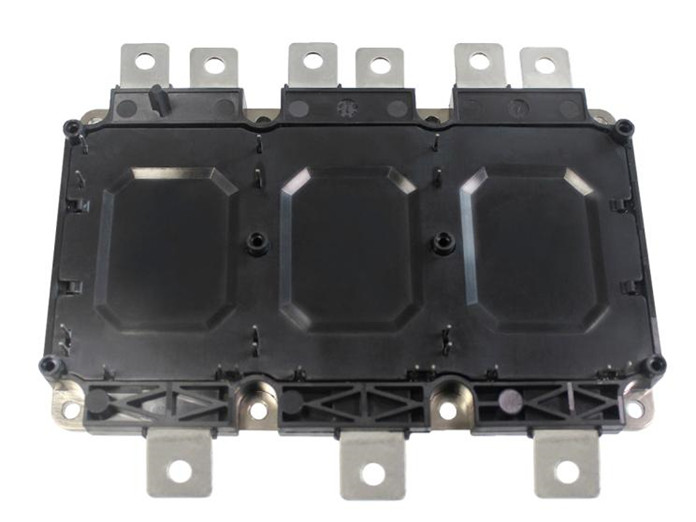
BYD Han will also feature the first-ever use of an independently-developed silicon carbide MOSFET (metal-oxide semiconductor field effect transistor) control module to reduce internal resistance, increase overcurrent capability of the electronic control system, and enable greater power and torque. Its drive motor assembly has a maximum speed of over 15,000 rpm.


The BYD Han will also use the “blade battery” utilizing BYD technology. The battery pack is inserted like a “blade”, hence its name. It is over 0.6m in length configured in an array. Based on lithium iron phosphate technology, its runaway temperature is higher than ternary lithium batteries; further boasting of higher rigidity, with a service life of over 1 million kilometers.
The BYD Han EV will have two power options: single and dual motor, with the latter version being an all-wheel drive. For the single motor version, peak power is at 222hp, maximum torque at 330 N · m, and NED cruising range at 605km. The dual motor version shares the same technical parameters with the single motor version; its rear motor will have a 272 hp maximum power output, 350 N · m peak torque; comprehensive maximum power will be 494 hp with a 550km NEDC range.
On the other hand, BYD Han DM will have a plug-in hybrid system; a 2.0T 192hp engine and a motor with maximum power of 245hp and 330 N · m torque. The car will utilize a ternary lithium battery that uses 17.1kWh/100km every 100 kilometers giving it an NEDC cruising range of 81km when driven in pure electric mode.